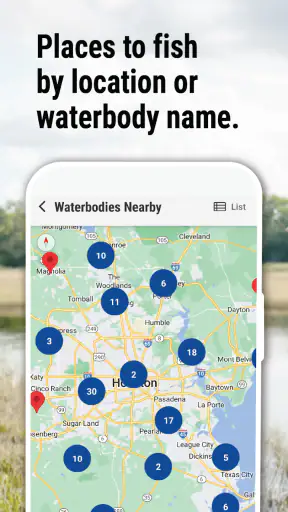
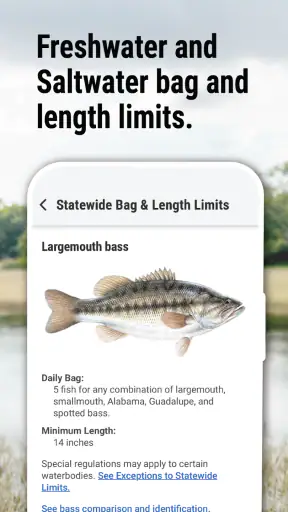
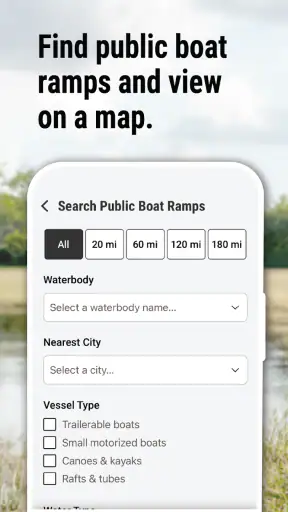
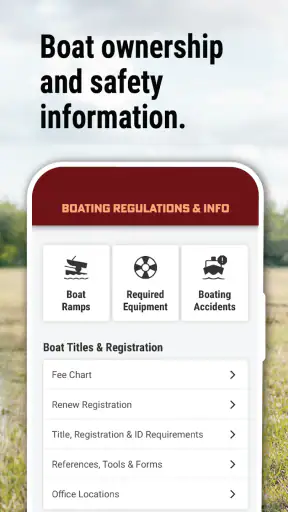
Texas Outdoor Annual
4.4337.00Reviews
Analysis ByAppCompare
When I head outdoors in Texas, I do not want to rely on a remembered rule, an old screenshot, or a search result that mixes current and outdated information. Texas Outdoor Annual is built for that exact moment: checking hunting and fishing regulations while I am preparing to leave, standing at the water, or already in the field. It is a free sports app from the Texas Parks and Wildlife Department, and its value comes less from entertainment than from putting official outdoor guidance in a format I can consult quickly.
After using it as a practical reference rather than treating it like a conventional sports app, I found it most useful for answering small but important questions before they become expensive mistakes. Which rules apply to the place I am visiting? What should I confirm before keeping a fish or beginning a hunt? Is the information I saved from a previous season still the information I should follow now? The app does not replace preparation, but it gives that preparation a sensible home on a phone.
How Texas Outdoor Annual fits into a real outdoor routine
The app’s current position is straightforward. It is an official regulations companion for people who hunt or fish in Texas, not a social network, map service, weather tool, or wildlife-identification camera. That focus is a strength. I can open it with a specific question in mind instead of filtering through unrelated content, advertisements, user comments, or broad outdoor articles.
Its category is listed as Sports, although I would describe it more accurately as a field reference. The developer is the Texas Parks and Wildlife Department, which gives the app a clear connection to the authority responsible for the material. It has reached over 500 thousand installs and holds a 4.4 average from around 1.3 thousand ratings, with roughly 337 written reviews. Those figures suggest that many people use it as a practical companion, but they do not change the main test: can I find the rule I need before acting?
For a typical fishing morning, my useful workflow starts before I leave home. I first identify the water body and the kind of fishing I expect to do. Then I use the app to review the relevant regulations instead of assuming that a rule from another lake, county, or season will carry over. That habit is more valuable than simply installing the app and hoping to remember that it is there.
The same approach works for hunting. I would check the applicable information while planning the trip, then open the app again at the point where a decision matters. A phone screen is not always comfortable in bright sun, with cold hands, or while wearing gloves, so I prefer to do the detailed reading before arriving and use the app outdoors for confirmation. That two-stage workflow is one of the best ways to get practical value from it.
What the current version means in practice
The current version is 11.0.2, while the app’s release history goes back to August 15, 2014. I see that long lifespan as evidence of an established reference tool rather than a short-lived experiment. It also creates a reasonable expectation that returning users may notice changes in organization or presentation over time, even when the basic purpose remains the same.
For someone installing it today, the important point is that the app is not presented as a general-purpose outdoor platform that happens to include regulations. Its identity has stayed centered on Texas hunting and fishing information. That makes it easier to recommend to a new Texas angler or hunter who wants a focused official resource, but less suitable for someone looking for trip planning, navigation, equipment advice, or a community feed.
The minimum operating-system requirement is Android 7.0, so the app remains accessible on many older Android phones. That matters for outdoor use because people often keep a tougher, older handset for camping, boating, or hunting rather than taking their newest phone into rough conditions. The trade-off is that an older device may make reading long sections or switching between topics slower and less comfortable than on a modern screen.
It is also free and rated for Everyone. I appreciate that combination here because the audience includes families learning outdoor rules together, occasional anglers, experienced hunters, and people who may only need the app for one trip. There is no financial barrier to keeping it available as a backup reference, although free access does not remove the need to read the rules carefully.
Changes and the experience for returning users
The version number and the app’s long presence point to an evolving product, but I would be careful about interpreting every update as a major new capability. For this kind of tool, useful evolution can be quiet: clearer navigation, better handling of current regulation material, or a more dependable way to reach the right section. Those improvements matter because a regulation app is judged by the moment it saves, not by how many flashy features it adds.
Existing users should approach an updated release with the same discipline they would use when opening a new regulation booklet. Do not assume that a familiar path means the content is unchanged. If I have used the app in a previous season, I would revisit the sections relevant to my next trip rather than relying on memory or an old saved note. The app can make checking easier, but it should encourage a fresh check, not replace one.
This is also where the official source matters most. A friend’s message, a forum answer, or a photograph of a printed page may be useful for starting a question, but they are weaker as a final reference when the details affect what I can legally do. I would use those informal sources for local context and use Texas Outdoor Annual to verify the regulation itself.
A subtle benefit for experienced users is that the app can reduce the gap between “I think I know this” and “I have checked this.” Outdoor rules often involve details that are easy to blur together after several trips. Opening the relevant material takes less effort than reconstructing a rule from memory, especially when traveling to a location I have not visited recently.
A practical workflow for fishing and hunting trips
My preferred setup is simple. Before the trip, I write down the questions I need answered: location, activity, season, limits, and any equipment or method detail that could affect the decision. I then use the app to work through those questions one at a time. This is better than casually browsing because it exposes gaps in my preparation.
For fishing, I would avoid treating a general rule as automatically sufficient for every destination. I would confirm the specific place and species-related information that applies to the outing, then take a moment to distinguish what I need to know before casting from what matters after catching a fish. That separation helps prevent the common mistake of remembering a broad allowance while overlooking a more specific restriction.
For hunting, I would check the information before loading the vehicle and again before heading into unfamiliar ground. A useful habit is to read the regulation in full rather than stopping at the first sentence that appears to answer the question. Short summaries are convenient, but the surrounding conditions can be just as important as the headline rule.
One non-obvious trade-off is that a regulation app is most helpful when I already know enough about my trip to ask a precise question. If I open it without knowing the location, activity, or target species, I can still learn, but the reading becomes less efficient. Beginners should therefore use it alongside a trip checklist, not as a substitute for deciding where and how they intend to go.
Another useful habit is to check the app before leaving service coverage. I would not plan on discovering every detail for the first time beside a remote shoreline or trail. Even when a phone appears connected, reception can change quickly outdoors. Reading the important material in advance and keeping the app ready for confirmation gives me a safer workflow than depending on an urgent lookup at the last minute.
Where it is stronger than ordinary alternatives
The usual alternative is a web search. Search is excellent when I do not know the name of the rule or want broader explanations, but it can return old pages, unofficial interpretations, or results that are technically relevant but not specific to my location. Texas Outdoor Annual has a narrower purpose, and that narrowness is exactly why I would reach for it first when the question is about Texas hunting or fishing regulations.
Another alternative is a printed annual guide. Paper is dependable when the phone battery is low, the screen is hard to read, or I want to mark several pages with a pen. It can also be easier to share around a camp table. The app wins when I want a portable reference without carrying extra material, especially during preparation or when my plans change.
Advice from local anglers and hunters has a different value. Experienced people can explain how a rule affects a particular trip, and their practical knowledge can make the wording easier to understand. However, local confidence is not the same as official confirmation. I would combine that advice with the app rather than choosing one and dismissing the other.
General outdoor apps may offer maps, weather forecasts, catch logs, or equipment tools, and those can be better for planning the wider outing. Texas Outdoor Annual is not trying to replace them. In my view, the sensible combination is to use a map or weather app for logistics and this one for the rules. Expecting one app to do both jobs would make the comparison unfair and could leave important regulatory questions buried among unrelated features.
Limitations that affect the decision
The biggest limitation is its narrow scope. If I want navigation to a boat ramp, a detailed weather forecast, a fishing diary, or a way to identify an unfamiliar species, I need another tool. The app’s focus makes regulation checking cleaner, but it also means it cannot serve as my complete outdoor kit.
Reading regulations on a phone has practical friction too. Long text can be tiring, especially under harsh sunlight or when I am moving between activities. A small display makes it harder to compare two sections at once, and outdoor conditions are not ideal for careful reading. I would not wait until the moment of a difficult decision to begin studying a complicated rule.
There is also a human limitation that no interface can solve: an official reference is only useful if I apply the correct section to the correct situation. A quick scan can create false confidence. I need to pay attention to the place, activity, timing, and any conditions attached to the rule. If the wording is unclear, I would pause and seek clarification from the appropriate authority rather than treating the most convenient interpretation as permission.
People who primarily enjoy sports outside Texas should skip this app. Its value is tied to Texas regulations, so it is not a sensible choice for someone who wants a nationwide hunting guide or information for another state. Likewise, users looking for a social experience, achievements, live tracking, or entertainment will find the app too utilitarian.
Who should install it and how to use it well
I would recommend it to Texas residents who fish or hunt even occasionally, visitors preparing for a Texas outdoor trip, and families teaching younger people how to approach outdoor rules responsibly. It is especially useful for the person who tends to say, “I remember the rule,” because that is exactly when a quick official check can prevent an avoidable problem.
I would be more cautious about recommending it as the only resource for a first-ever trip. Newcomers still need to understand their equipment, location, safety planning, and the difference between general guidance and the rules that apply to their exact outing. The app can support that learning process, but it does not turn an inexperienced user into a prepared one by itself.
My most useful tip is to make the app part of the departure checklist rather than an emergency tool. Check it while the phone is charged, identify the relevant sections, and revisit them if the destination or activity changes. A second tip is to avoid relying on a screenshot taken months earlier. A saved image may be convenient, but a current check is more responsible than assuming an old reference still fits today’s plan.
A third tip is to explain the rule aloud to the person traveling with you. If I cannot summarize what I just read in plain language, I probably need to read it again. This is particularly helpful when sharing a boat, vehicle, or hunting plan, because everyone involved should understand the boundaries rather than leaving one person to carry the entire burden of remembering them.
My recommendation after using the current release
Texas Outdoor Annual succeeds because it treats regulations as the main job. The official connection, free availability, broad reach, and support for Android 7.0 make it an approachable tool for a wide range of Texas outdoor users. Its 11.0.2 release shows that the app is still maintained as a current product rather than being left as a static reference from its original launch period.
I would install it before a Texas fishing or hunting trip, but I would use it with realistic expectations. It is not a map, forecast, logbook, or substitute for careful judgment. Its best role is more specific and more valuable: helping me check the rules that govern the activity I am about to undertake.
The people who benefit most are those willing to prepare before arriving outdoors. If I read the relevant material in advance, use the app to confirm details, and avoid treating a quick glance as a complete interpretation, it becomes a dependable part of my routine. If I want a single app to organize every part of an outdoor adventure, I should look elsewhere and keep this one as the regulation specialist.
For that reason, my final view is positive but practical. Use Texas Outdoor Annual as a verification tool, not as a replacement for preparation. That distinction captures both its strongest feature and its main limitation. It will not plan the whole trip for me, but when my question is whether a Texas hunting or fishing rule applies to what I am about to do, it is the app I would want ready on my phone.
FAQ
What is the Texas Outdoor Annual app used for?
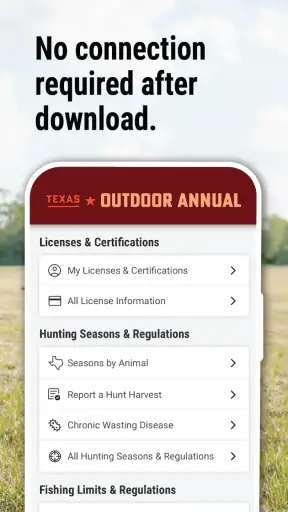
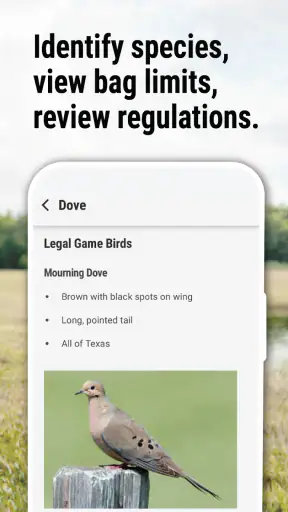
Texas Outdoor Annual is a practical reference app for people who fish, hunt, or enjoy other outdoor activities in Texas. It brings together current regulations, season dates, bag limits, legal methods, license information, and other guidance from the Texas Parks and Wildlife Department. After installing it, users can check important rules while planning a trip instead of relying on printed booklets or outdated information.
Does Texas Outdoor Annual include hunting and fishing regulations for all of Texas?
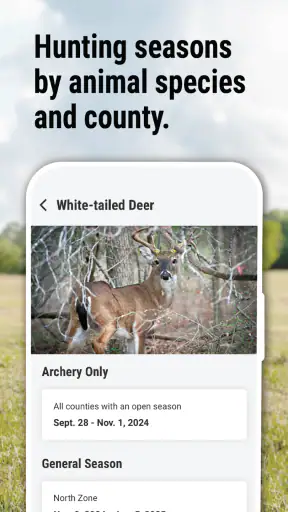
The app is designed to provide statewide Texas hunting and fishing information, including rules that may vary by species, county, water body, season, or management area. It can cover general regulations as well as special provisions, but users should still read the complete section that applies to their exact location and activity. Local restrictions and temporary changes may affect what is legal.
Can I use Texas Outdoor Annual without an internet connection?
Many users install the app because it is convenient to consult regulations in the field, where mobile coverage may be weak or unavailable. However, offline behavior can depend on the app version and whether its content has already been downloaded or cached. It is best to open the relevant pages before leaving home, update the app regularly, and avoid assuming every feature works offline.
Is Texas Outdoor Annual a substitute for a Texas hunting or fishing license?
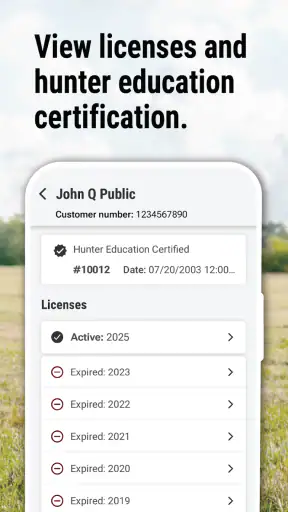
No. Texas Outdoor Annual is an information and regulations guide, not a replacement for a license, permit, stamp, registration, or other document required for your activity. Before hunting or fishing, confirm which credentials apply to you and carry any required proof. The app can help explain requirements, but official Texas Parks and Wildlife information should be used to verify licensing details.
How often is the information in Texas Outdoor Annual updated?
Outdoor regulations can change from one season to another, and special rules may also be introduced during the year. The app is intended to provide updated Texas Parks and Wildlife information, but users should check the displayed publication or regulation period and install available updates before every trip. For unusual situations, emergency changes, or unclear rules, confirm the information through the official TPWD website or office.
Pros
- Official Texas Parks and Wildlife regulations and season information.
- Covers hunting
- fishing
- and boating rules in one app.
- Works offline after content is downloaded.
- Search tools make specific regulations easier to find.
- Free to download with no subscription required.
Cons
- Information can feel dense for first-time outdoor users.
- Some regulations vary by county or management area.
- Updates may require downloading a new content package.
- Limited trip-planning and navigation features.
- Requires careful reading to avoid confusing exceptions.